

 English
  中文简体
中文简体  Español
Industry News

2026-07-01
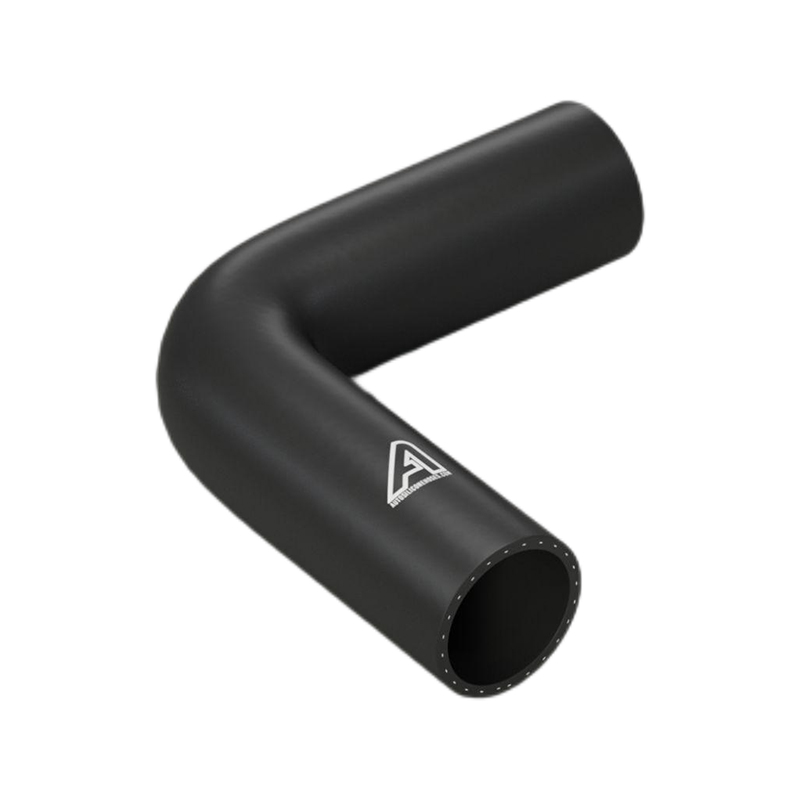
Straight radiator hoses can only do so much in a modern engine bay, where the radiator, water pump, and engine block rarely line up on a single axis. Rubber coolant radiator elbows solve this by pre-forming the bend — commonly at 45°, 90°, or 180° — directly into the hose, avoiding the sharp kinks and restricted flow that would occur if a straight hose were forced into a tight bend by hand. A kinked straight hose doesn't just reduce coolant flow; the compressed inner wall at the bend point is also where premature cracking and hose failure most often start, since that section of the hose is under constant mechanical stress in addition to heat and pressure cycling.
EPDM (Ethylene Propylene Diene Monomer) is the standard material for most rubber coolant radiator elbows, and for good reason: it handles continuous operating temperatures up to roughly 150°C, resists ozone, UV, and weathering well enough for long service life under the hood, and remains flexible across a wide temperature range without cracking. Its main limitation shows up in extreme-heat applications — turbocharged engines, racing, or industrial equipment running consistently near its upper temperature limit — where the margin for error narrows.
Silicone elbows extend that ceiling significantly, with some formulations rated up to 250°C, and they hold their flexibility and shape far better over repeated heat cycling than EPDM does. That performance comes at a real cost premium, though, which is why silicone tends to be reserved for performance vehicles, industrial equipment operating in harsh thermal environments, and applications where hose replacement is difficult or costly enough that the longer service life justifies the higher upfront price.
| Property | EPDM | Silicone |
|---|---|---|
| Max operating temp | ~150°C | Up to 250°C |
| Cost | Lower | Higher |
| Typical use | Standard passenger vehicles, general industrial | Racing, turbo engines, harsh thermal cycling |
Comparison of EPDM and silicone as base materials for rubber coolant radiator elbows.
Rubber alone can't hold shape reliably under the pressure cycling of an active cooling system, which is why quality rubber coolant radiator elbows use a textile cord reinforcement layer — commonly polyester or aramid — embedded between the inner tube and outer cover. This reinforcement layer is what actually gives the hose its pressure rating and prevents ballooning or collapse at the bend, where wall stress is naturally concentrated. Buyers comparing suppliers should ask specifically about the reinforcement material and pressure rating rather than judging quality by wall thickness alone, since two elbows can look identical in cross-section while having very different burst pressures.
SAE J20 is the primary industry benchmark for automotive coolant hoses, covering temperature resistance, pressure performance, and ozone/aging resistance under simulated service conditions. Hoses rated to SAE J20 Class A or Class D1 (a common EPDM classification) indicate the manufacturer has tested against these benchmarks rather than relying on generic material specs. For international or industrial sourcing, ISO 4081 and DIN 73411 serve a similar verification role in markets outside SAE-governed regions, and reputable suppliers should be able to provide test reports on request rather than just a datasheet.
Contact Us
Copyright ©
Jiaxing Tosun Rubber&Plastic Co., Ltd.
All Rights Reserved.
Custom Rubber And Plastics Products Factory