

 English
  中文简体
中文简体  Español
Industry News
Home / News / Industry News / EPDM vs Silicone: Choosing the Right Rubber for High-Temperature Automotive

2026-09-21
Under the hood of a modern turbocharged engine, an EPDM or silicone coolant hose can sit 15 centimeters from an exhaust manifold that radiates 700 degrees Celsius of heat. The air around it climbs past 120 degrees Celsius in stop-and-go traffic, the ethylene glycol coolant inside it runs at 115 degrees Celsius, and the clamp on its fitting carries the whole responsibility for keeping two bars of pressure off the engine bay. That is the operating envelope where the EPDM vs. silicone decision happens for high-temperature automotive components. Both materials resist heat, but they fail differently, cost differently, and belong on different parts. This guide compares EPDM and silicone with the engineering data a design or sourcing engineer can apply directly: continuous temperature limits, fluid compatibility, compression set, cost per part, and component-level recommendations.
EPDM is rated for continuous service at 150 degrees Celsius with short peaks to 170 degrees Celsius, while standard silicone compounds carry a 230 degrees Celsius continuous rating; however, that 80-degree advantage applies only to dry heat, not to coolant, steam, or oil contact.
Underhood thermal loads are uneven. Exhaust manifolds and turbochargers dominate one side of the engine bay, while coolant circuits stay below 130 degrees Celsius. A rubber part fails at the hottest point on its own surface, not at the ambient sensor reading. In a typical front-wheel-drive sedan, an EPDM radiator hose near the radiator outlet sees 135 to 150 degrees Celsius for sustained periods; a silicone boot on a turbo actuator sees 200 to 230 degrees Celsius. Both ratings collapse when the surrounding fluid changes, which is why material selection always combines temperature with media exposure.
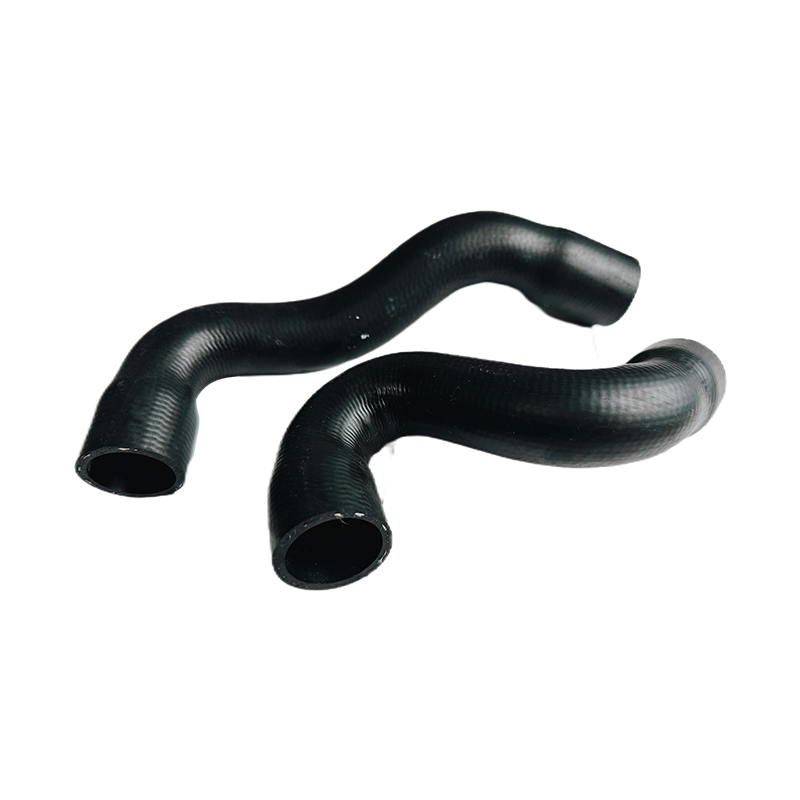 EPDM Reinforced Radiator Coolant Hose for Automotive Cooling SystemsThis EPDM hose with synthetic yarn, polyester, and aramid reinforcement suits coolant and brake fluid circuits. Its temperature range and chemical resistance make it a dependable choice for radiator, heater, and bypass connections under sustained heat.View Product →
EPDM is the reference polymer for ethylene glycol coolant, plain water, steam, and DOT 3 or DOT 4 brake fluid, whereas silicone must stay away from pressurized steam and hot coolant; silicone is the better choice for some oils and solvents that destroy EPDM's saturated polymer backbone.
EPDM's carbon-carbon backbone resists hydrolysis, so after 100,000 kilometers of coolant circulation, the hose wall swells less than 5 percent in most OEM coolant formulations. Silicone absorbs coolant additives more readily; prolonged exposure to hot ethylene glycol softens the wall and raises leak risk at the clamp gap. Pressurized steam is the sharper divider: steam attacks the siloxane network of silicone, while EPDM is a standard material for steam hoses. On the oil side, EPDM swells aggressively in petroleum oils and fuels; silicone swells less in the same fluids, but it is still not an oil-seal material. Both materials show near-perfect resistance to ozone and ultraviolet light, which is why door and window seals are made from both. In a standard ozone test of 50 parts per hundred million for 72 hours at 40 degrees Celsius, neither compound develops visible cracks.
| Fluid or condition | EPDM behavior | Silicone behavior |
| Ethylene glycol coolant at 120 C | Excellent, swell below 5 percent | Fair, softening and additive absorption risk |
| Pressurized steam | Excellent | Poor, siloxane network hydrolysis |
| Mineral engine oil | Poor, strong swelling | Moderate, limited short-term use |
| DOT 3 / DOT 4 brake fluid | Excellent | Moderate |
| Ozone and ultraviolet exposure | Excellent, no cracking in 72 h test | Excellent, no cracking in 72 h test |
| Dilute acids and alkalis | Good | Fair, concentrated media attack the polymer |
Definition: hydrolysis resistance is a polymer's ability to resist chemical breakdown by water. EPDM's saturated backbone gives it the best hydrolysis resistance among heat-resistant automotive elastomers, which is why coolant systems are designed around EPDM.
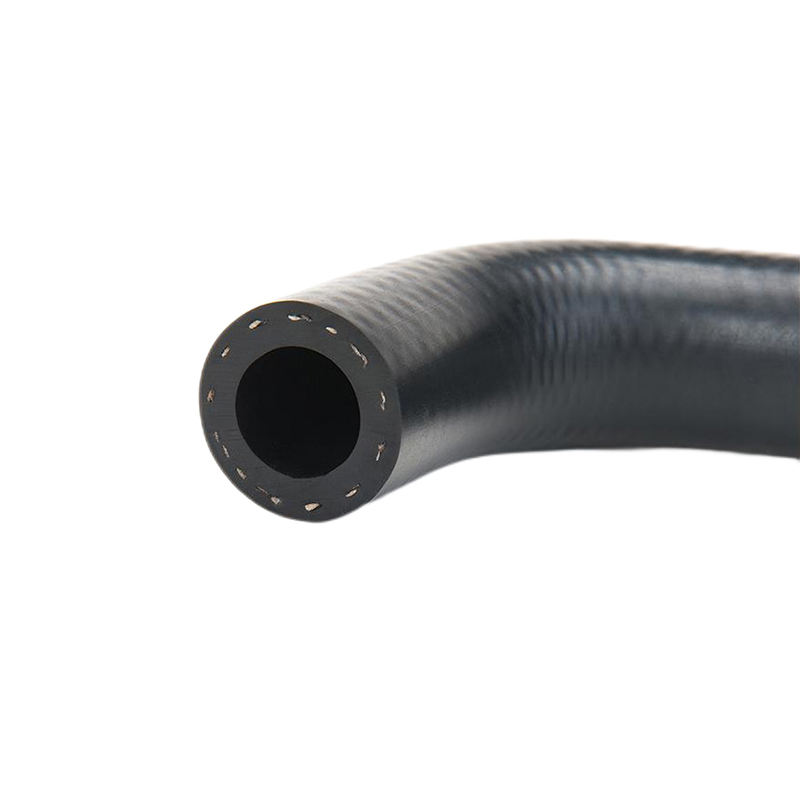 Extruded Rubber Heater Water Hose with Multiple Polymer OptionsThis extruded hose can be made from NBR, FKM, ACM, AEM, or HNBR, covering varied fluid and temperature needs. It meets SAE J20 classes, making it suitable for heater and coolant lines where hydrolysis resistance matters.View Product →
At 150 degrees Celsius and 25 percent strain for 70 hours, a typical EPDM seal retains 75 to 85 percent of its original deflection, while a conventional silicone seal retains 50 to 70 percent; this difference is why silicone hoses need constant-tension or re-torqued clamps to stay leak-free.
Compression set measures how much of a squeezed shape a rubber remembers after the load is removed. When the rubber forgets, the clamp loosens, coolant drips, and the service ticket reads "leak at the clamp" rather than "tube wall failure." EPDM's shorter, denser crosslinks hold the compressed network in place at 150 degrees Celsius. Silicone's siloxane backbone relaxes faster under sustained load, especially in thin hose walls and gaskets, so the industry compensates with spring-loaded clamps, thicker walls, or a design change back to EPDM.
Mechanical strength also separates the pair. EPDM compounds deliver 8 to 20 megapascals of tensile strength and substantially better tear resistance; silicone compounds sit at 5 to 10 megapascals and tear easily if a clamp edge or installation tool nicks the surface. That weakness shows up in continuously flexing parts such as bellows and dust covers.
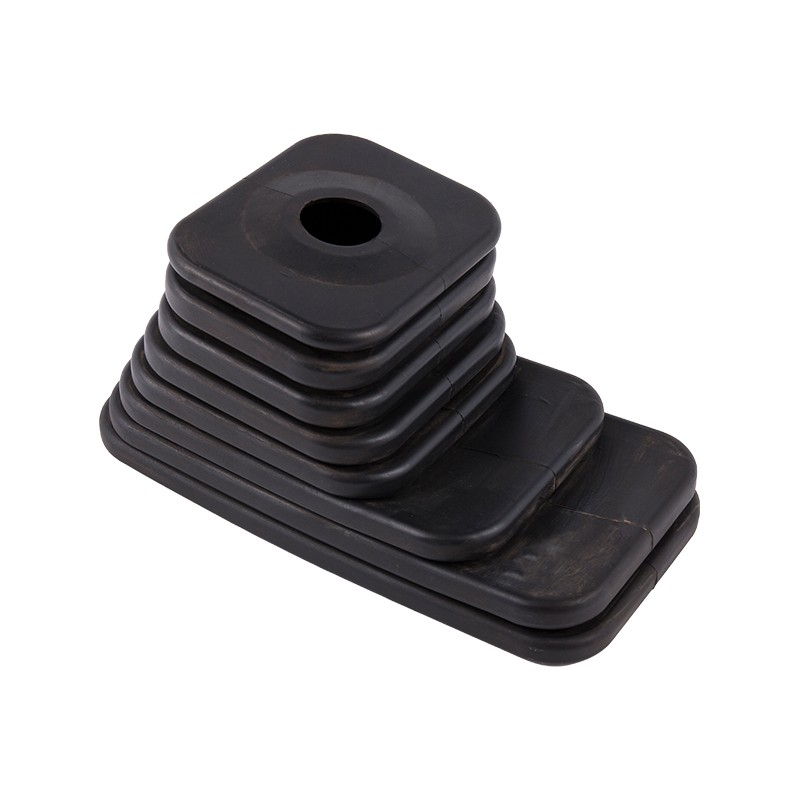 NBR/PVC Corrugated Dust Cover Bellows for Dynamic SealingThese corrugated bellows combine NBR oil and fuel resistance with PVC weather protection. Their flexible design handles bending and stretching, making them ideal for drive shaft, suspension, and hydraulic component covers in demanding environments.View Product →
Raw material cost is the first divider: EPDM compounds typically cost 2 to 4 USD per kilogram, silicone compounds 8 to 15 USD per kilogram, and because EPDM density is about 0.9 grams per cubic centimeter versus 1.2 for silicone, the per-part material spread reaches 3 to 4 times before molding labor is counted.
Molding economics reinforce the gap. EPDM cures quickly in compression molding and transfer molding, releases cleanly from tooling, and flashes trim easily; silicone needs longer cure cycles, careful mold release, and sometimes a post-cure oven. On a high-volume automotive grommet produced at 500,000 pieces per year, the compound cost alone swings annual spend by five to six figures. That is why OEMs specify EPDM wherever the temperature requirement stays below 150 degrees Celsius, and why part consolidation studies start with EPDM and move to silicone only after thermal simulation proves a need.
Supply chains behave differently. EPDM polymer supply is broad and stable across multiple global producers; silicone feedstock follows silicon metal prices, which have swung by 2 to 3 times within a single contract year. Both materials cure in the same compression presses, so a custom molder such as Jiaxing Tosun Rubber & Plastic Co., Ltd. can switch compounds without new capital equipment, but tooling, cure cycles, and validation still must be re-qualified for each material.
Higher per-part material cost for silicone. On a 500,000-piece annual program, this is a five-to-six-figure difference.
Specify EPDM for every coolant-carrying, water-sealing, and weather-exposed rubber part that operates below 150 degrees Celsius; reserve silicone for dry-heat zones above 150 degrees Celsius, electrical insulation, and low-temperature sealing down to minus 60 degrees Celsius.
The matrix below reflects OEM specification practice and the physical limits of each polymer family. Maximum surface temperature is the value to measure at the hottest operating point, not the coolant bulk temperature.
| Component | Max surface temperature | Recommended material | Primary reason |
| Radiator coolant hose | 150 C | EPDM | Best coolant resistance and compression set |
| Heater water hose | 140 C | EPDM | Lowest cost per meter with proven durability |
| Turbo air duct boot | 190 C | Silicone | Dry heat above the EPDM ceiling |
| Spark plug or ignition boot | 210 C | Silicone | Electrical insulation plus dry heat |
| Dust cover or bellows near exhaust | 170 C | Silicone or heat-shielded EPDM | Balance of flex life and heat exposure |
| Door and window weather seal | 90 C | EPDM | Weathering resistance and low cost |
Quick answer: use EPDM below 150 degrees Celsius when coolant, steam, or weather is present; use silicone above 150 degrees Celsius when the heat is dry and the part can tolerate higher compression set.
No. EPDM's continuous rating is 150 degrees Celsius, with brief peaks to 170 degrees Celsius. Above that range the polymer oxidizes rapidly, stiffens, and cracks; antioxidant packages do not change this physical ceiling.
Only when the coolant line also must resist continuous dry heat above 150 degrees Celsius, such as a route along the exhaust side. In that case, use a silicone hose with constant-tension clamps and budget for more frequent clamp checks.
Because silicone's compression set at 150 degrees Celsius is significantly higher than EPDM's. The material relaxes under clamp pressure, the gap opens, and the leak starts without any visible crack in the hose wall.
Use an ASTM D2000 line callout. EPDM parts commonly carry CA or DA type codes with class A fluid swell limits, and silicone parts carry FC, FE, or GE codes depending on the required temperature line. A full callout such as M2GE 607 A1-10 B33 tells the molder both the material family and the test conditions.
Contact Us
Copyright ©
Jiaxing Tosun Rubber&Plastic Co., Ltd.
All Rights Reserved.
Custom Rubber And Plastics Products Factory