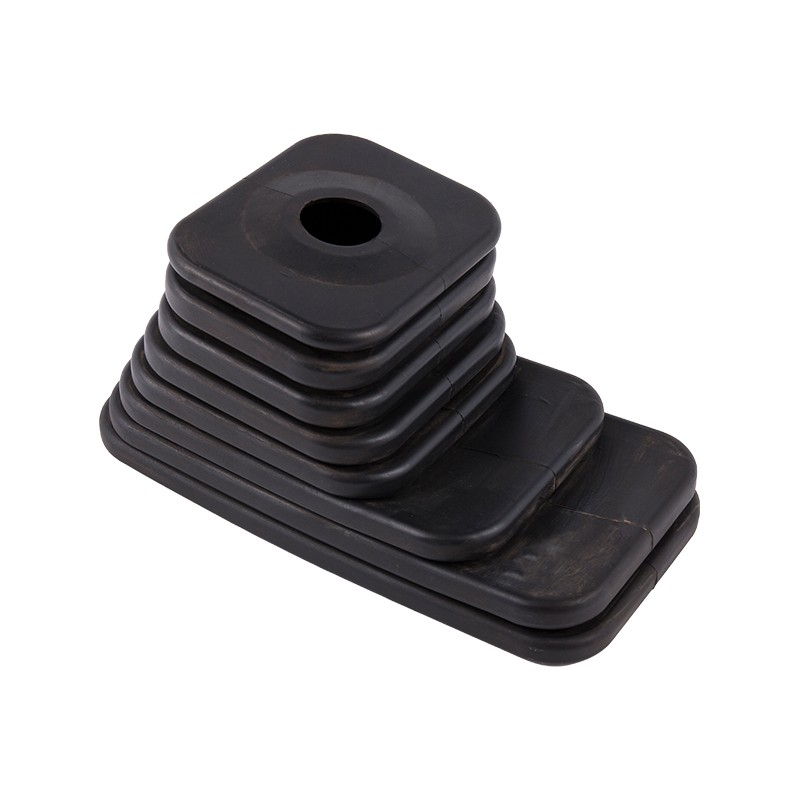
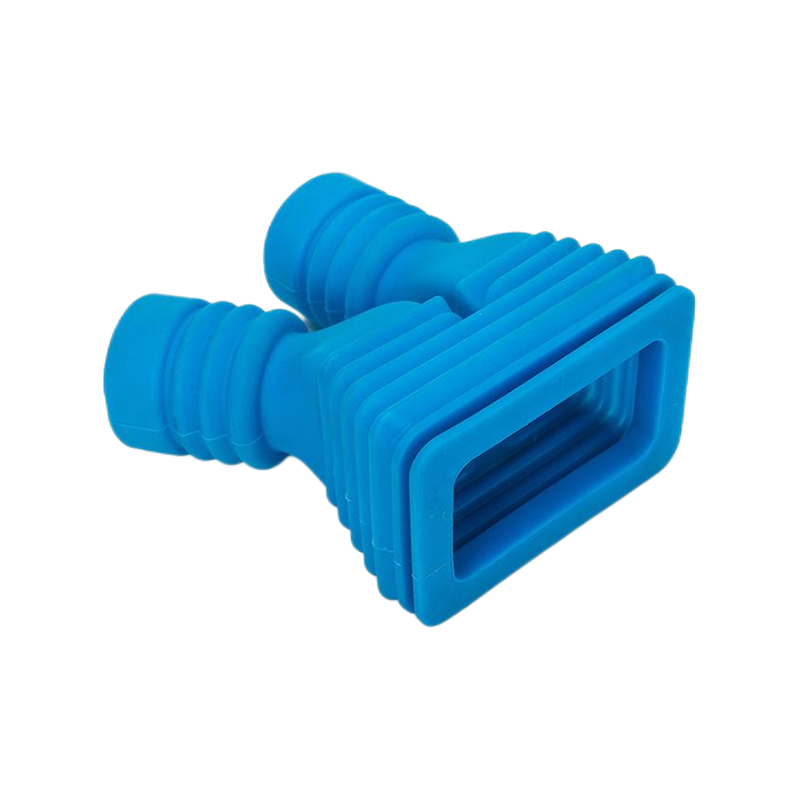
A rubber bellows is a flexible, accordion-like protective cover or connector made from elastomeric materials. Its primary job is to seal out dust, dirt, moisture, and other contaminants while accommodating movements such as expansion, compression, bending, and misalignment in mechanical systems. By forming a tight barrier around vulnerable components like shafts, rods, joints, and ball screws, rubber bellows extend the service life of machinery up to 3 times longer than unprotected parts in harsh environments. They are essential in industries from automotive and aerospace to heavy construction equipment, and they can be custom-molded or sewn to fit specific travel lengths and diameters.
At its core, a rubber bellows is a cylindrical or conical component with a series of convolutions—alternating peaks and valleys—that give it a spring-like ability to flex. It can be manufactured through molding, dipping, or blow-molding processes, and may include fabric reinforcement layers for increased strength and pressure resistance. Unlike metal bellows, rubber bellows offer superior vibration damping, noise reduction, and the ability to handle non-axial movements. A typical industrial rubber bellows can compress to 10–20% of its extended length, meaning a 100 mm long bellows might collapse to just 10–20 mm, providing excellent stroke accommodation in compact spaces.
Key Functions and Protective Benefits
The bellows performs several vital functions that go beyond simple sealing. Its protective benefits are measurable and directly reduce maintenance costs.
- Exclusion of contaminants: The convoluted structure traps and diverts dust, metal chips, water, and abrasive particles away from precision bearings, lead screws, and hydraulic cylinder rods. This prevents abrasive wear that causes premature failure.
- Retention of lubricants: Grease and oil stay inside the protected joint, ensuring consistent lubrication. A torn bellows on a CV (constant velocity) joint can cause grease loss and joint failure in as little as 500 miles of driving.
- Accommodation of movement: Bellows can handle axial extension and compression, lateral offset, and angular deflection simultaneously. A single rubber bellows can typically tolerate up to 15 degrees of angular misalignment without losing the seal.
- Vibration and noise isolation: The elastic rubber absorbs oscillations, protecting connected components from fatigue and reducing transmitted noise by 3–8 decibels compared to rigid covers.
- Pressure and temperature containment: In ducting and piping, rubber bellows act as flexible connectors to absorb thermal expansion and vibration. They can handle internal pressures from vacuum up to 50 psi (3.4 bar) depending on reinforcement.
Common Rubber Bellows Materials and Their Properties
The choice of rubber compound determines chemical resistance, temperature range, and longevity. The table below compares four widely used elastomers for bellows manufacturing.
| Material |
Temperature Range |
Key Resistances |
Typical Applications |
| EPDM |
-40 to 300 deg F (-40 to 150 deg C) |
Ozone, UV, weather, water, steam |
Outdoor equipment, automotive boots, HVAC connectors |
| Neoprene |
-30 to 250 deg F (-34 to 120 deg C) |
Oils, greases, refrigerants, weathering |
Refrigeration systems, machinery covers, cable seals |
| Silicone |
-65 to 450 deg F (-54 to 232 deg C) |
Extreme temperatures, UV, ozone, some chemicals |
Aerospace ducting, food-grade covers, medical devices |
| Natural Rubber |
-50 to 160 deg F (-46 to 71 deg C) |
Abrasion, tear, dynamic flexing |
High-flex CV boots, vibration isolators, loading dock seals |
Comparison of common elastomer materials used for rubber bellows, with typical performance ranges and suitable applications.
Types of Rubber Bellows by Shape and Construction
Different shapes and manufacturing methods create bellows suitable for specific installation conditions and travel requirements.
- Convoluted bellows: The most common type, with uniform or varying convolution heights. They can be straight cylindrical, tapered, or cone-shaped. A cone bellow is ideal when one end is fixed larger and the other smaller, such as covering a tapered spindle. Convolution geometry determines the compression ratio; a deep convolution can achieve a compression of 90%.
- Seamless molded bellows: Produced as a single piece without seams, offering the highest integrity seal against liquids. These are used in hydraulic cylinder rod covers where water ingression would be catastrophic. Maximum length is limited by mold size, typically up to 24 inches (600 mm) for standard tooling.
- Sewn or fabricated bellows: Made from rubber-coated fabric sheets cut and sewn, then seam-sealed. These can be produced in very long lengths exceeding 10 feet (3 meters) and large diameters, suited for protecting long ball screws and linear rails on machine tools. They are often called "way covers" in CNC machines.
- Blow-molded bellows: Used for ducts and lightweight protective covers. They have thin walls and are economical for high-volume production, such as automotive air intake boots.
Applications Across Industries
Rubber bellows are ubiquitous where moving parts must remain sealed. The following examples illustrate their range.
- Automotive: CV joint boots, steering rack bellows, and shock absorber dust covers. A torn CV boot is the leading cause of CV joint failure, with over 80% of CV joint replacements resulting from boot damage.
- Machine tools: Way covers on CNC lathes and milling machines protect precision linear guides from hot chips and coolant. A single chip embedded in a linear bearing can cause $5,000–$20,000 in damage and lost production time.
- Hydraulics and pneumatics: Cylinder rod bellows prevent scoring and seal damage from dirt. They can extend the life of hydraulic seals by 2–4 times in mining and construction equipment.
- HVAC and industrial ducting: Rubber bellows connectors absorb vibration and thermal expansion in piping systems, reducing stress on flanges and minimizing noise transmission.
- Railway: Inter-car gangway bellows connect train carriages, allowing flex while protecting passengers from weather, wind, and noise. They must withstand millions of cycles without cracking.
- Medical equipment: Silicone bellows in ventilators and respiratory devices provide a sterile, flexible air path that can be easily cleaned and autoclaved at 134 deg C.
Design Factors and Sizing Guidelines
Selecting or custom-designing a rubber bellows requires specifying a few critical dimensions and operating parameters. Manufacturers typically ask for:
- Extended length and compressed length: The fully stretched and fully collapsed lengths, which define the stroke. A typical bellows can compress to 15–25% of its extended length with standard convolutions. A bellows extended to 200 mm might compress to 30–50 mm.
- Mounting diameters: The inside and outside diameters at each end must match the shaft and the housing or clamp. Common clamping methods include hose clamps, tie wraps, or integrated cuffs.
- Environment and media: Temperature extremes, chemical splashes, UV exposure, and contact with oils or cutting fluids determine the rubber compound. For example, a bellow near a machine tool's coolant spray must be oil-resistant neoprene or nitrile, not EPDM.
- Pressure and vacuum requirements: If the bellows will experience internal pressurization, the wall thickness and fabric reinforcement must be specified. An unreinforced silicone bellows may only hold 5–10 psi, while a fabric-reinforced EPDM bellows can hold 30–50 psi.
- Cycle life expectancy: Bellows in dynamic applications like CV boots are designed for millions of cycles, but the rubber compound and convolution profile must be optimized. Natural rubber offers superior fatigue life, while silicone provides extreme temperature endurance.
Installation and Maintenance Best Practices
Correct fitting and periodic inspection maximize bellows lifespan. Install rubber bellows by first ensuring the protected shaft or rod is clean and dry. Slide the bellows into position without twisting, then secure each end with the appropriate clamp. Never stretch the bellows beyond its designed extended length during installation, as this can set permanent deformation and reduce stroke capacity. For split bellows that wrap around an assembly, align the seam away from the direction of contaminant spray.
Maintenance involves regular inspection for cracks, cuts, oil swelling, or hardening. In automotive applications, inspect CV boots at every oil change; a small tear caught early can be repaired with a boot replacement costing under $150, versus a full CV joint replacement at $400–$900. In machine tools, check way cover bellows for chip accumulation in the convolutions and wipe them clean. A properly maintained EPDM bellows on an outdoor hydraulic cylinder can last 8–12 years before replacement is needed. Replace any bellows that shows deep cracking or loss of elasticity to prevent catastrophic seal failure.



 English
  中文简体
中文简体  Español