

 English
  中文简体
中文简体  Español
Industry News

2026-06-01
Rubber is an elastic polymer that can be stretched, compressed, and deformed under force and then return to its original shape. It exists in two fundamental forms: natural rubber, derived from the latex sap of the rubber tree Hevea brasiliensis, and synthetic rubber, produced from petrochemical feedstocks through industrial polymerization. Both share the core property of elasticity but differ in composition, performance characteristics, and cost.
Natural rubber has been harvested and used for thousands of years. Pre-Columbian civilizations in Mesoamerica made rubber balls, waterproofed cloth, and footwear from latex long before European contact. The material's potential in industrial applications only became apparent in the 19th century after Charles Goodyear discovered vulcanization in 1839 — a process that transformed soft, sticky latex into the tough, resilient material recognized as rubber today.
Today, global rubber production exceeds 28 million metric tons per year, roughly split between natural and synthetic types. Thailand, Indonesia, and the Ivory Coast are the world's largest natural rubber producers. Synthetic rubber, first developed during World War II when natural rubber supplies were cut off, now accounts for approximately 60% of total rubber consumption worldwide.
The raw material for natural rubber is latex — a milky white colloidal suspension produced in the bark of Hevea brasiliensis trees. Latex is approximately 30–40% polyisoprene by weight, suspended in water with proteins, lipids, and trace minerals. The polyisoprene polymer chains are what give rubber its elasticity: they are long, coiled molecules that straighten under tension and spring back when released.
Synthetic rubbers are derived from monomers obtained primarily through petroleum refining and natural gas processing. The most important synthetic rubber raw materials include:
Silicone rubber occupies a category of its own — its polymer backbone is built from silicon and oxygen rather than carbon, making it chemically distinct from both natural and petroleum-derived rubbers. This gives silicone exceptional temperature resistance, biocompatibility, and UV stability that carbon-chain rubbers cannot match.
The journey from raw latex or synthetic polymer to a finished rubber product involves several stages, each of which significantly affects the final material's properties.
Latex is tapped from rubber trees by making a shallow diagonal cut through the bark. The sap drips into collection cups over several hours. Fresh latex is then coagulated — typically by adding formic or acetic acid — causing the rubber particles to clump together and separate from the watery serum. The resulting coagulum is pressed, rolled into sheets, and either smoked (to produce Ribbed Smoked Sheet, or RSS) or dried with hot air (to produce Technically Specified Rubber grades). These dried sheets or crumb rubber bales are the traded commodity form of natural rubber.
Raw rubber — whether natural or synthetic — is not used as-is. It is compounded with a range of additives on internal mixers (Banbury mixers) or open mills. A typical rubber compound contains:
Compounded rubber is shaped before vulcanization while it remains thermoplastic and workable. Common shaping methods include compression molding (pressing rubber into a heated mold under pressure), injection molding (injecting rubber into closed molds), transfer molding, extrusion (forcing rubber through a die to produce profiles, tubes, and strips), and calendering (rolling rubber into sheets or coating it onto fabric).
Vulcanization is the chemical process that converts soft, weak rubber into the strong, elastic material used in finished products. Heat causes sulfur atoms (or peroxide radicals) to form cross-links between adjacent polymer chains, creating a three-dimensional network. The degree of cross-linking determines hardness: lightly cross-linked rubber is soft and elastic; heavily cross-linked rubber becomes hard (ebonite). Most rubber products are cured in presses, autoclaves, or continuous vulcanization lines at temperatures between 140°C and 200°C.
Rubber's combination of elasticity, durability, impermeability, and electrical insulation makes it indispensable across an enormous range of industries. The single largest application by volume is tires — passenger, truck, and off-road tires account for approximately 70% of all rubber consumed globally. Beyond tires, rubber products appear throughout virtually every sector of modern industry and daily life.
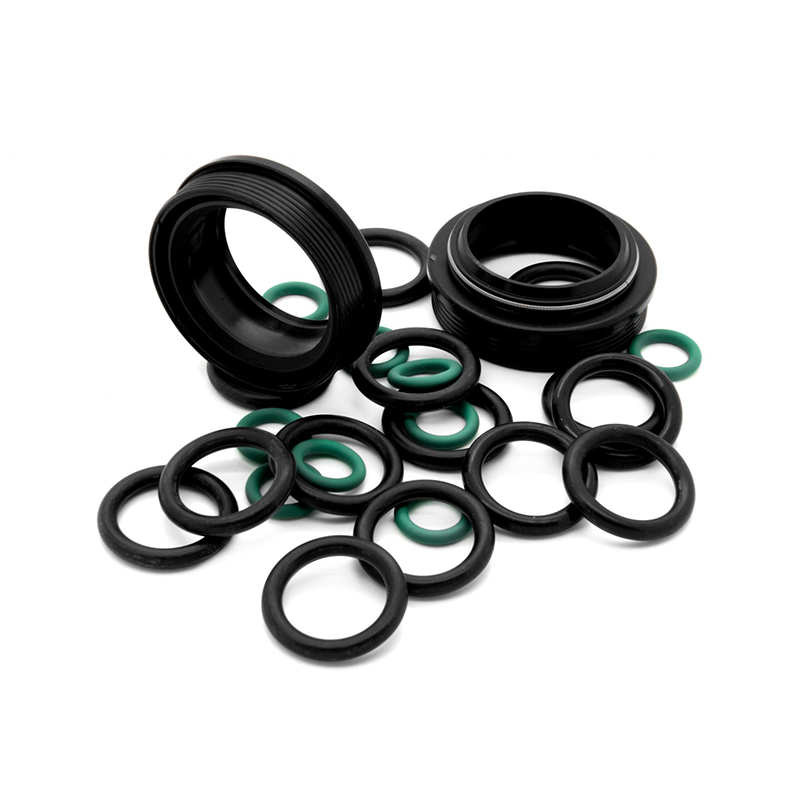
Rubber seals are among the most critical and widely specified rubber products in engineering. Their function is to prevent the passage of fluids, gases, or contaminants across a joint or interface — a task that requires the rubber to conform intimately to mating surfaces, compress under load, and maintain its elastic recovery over millions of cycles or years of static exposure.
The rubber compound used in a seal must be matched carefully to the service environment. Using the wrong material leads to swelling, hardening, cracking, or chemical dissolution — all of which cause seal failure and potentially catastrophic system leaks.
| Rubber Type | Temperature Range | Key Strengths | Typical Seal Applications |
|---|---|---|---|
| NBR (Nitrile) | −40°C to +120°C | Oil, fuel, and hydraulic fluid resistance | Hydraulic O-rings, fuel system seals, oil seals |
| EPDM | −50°C to +150°C | Ozone, UV, steam, and water resistance | Plumbing gaskets, HVAC seals, outdoor weatherstripping |
| Silicone (VMQ) | −60°C to +200°C | Extreme temperature range, biocompatibility | Food equipment, medical devices, oven door seals |
| FKM (Viton) | −20°C to +200°C | Aggressive chemical and fuel resistance | Chemical processing, aerospace, high-performance automotive |
| Neoprene (CR) | −40°C to +120°C | Weathering, ozone, and moderate oil resistance | Refrigeration seals, marine applications, window seals |
| Natural Rubber (NR) | −50°C to +80°C | High resilience, excellent tear strength | Water seals, pneumatic applications, bearing seals |
Beyond material selection, seal performance depends on durometer (hardness), surface finish of mating parts, compression set resistance, and the presence of lubricants or coatings. For critical applications — aerospace, subsea, high-pressure hydraulics — seal design involves finite element analysis of contact stress and accelerated aging tests to verify performance over the required service life.
Contact Us
Copyright ©
Jiaxing Tosun Rubber&Plastic Co., Ltd.
All Rights Reserved.
Custom Rubber And Plastics Products Factory