

 English
  中文简体
中文简体  Español
Industry News
Home / News / Industry News / What Makes Extruded Rubber the Go-To Choice for Demanding Applications?

2025-12-11
In the world of industrial and commercial component design, material selection is paramount. Engineers and designers constantly seek solutions that offer a precise balance of durability, flexibility, and cost-effectiveness. The answer, more often than not, lies in extruded rubber. This versatile material and its specialized manufacturing method allow for the creation of components—from simple cords to intricate custom gaskets—that consistently perform under stress. This article delves into the inherent advantages of this process, exploring how it delivers the critical performance required in applications ranging from automotive to construction, and how specialized compounds meet the challenge of extreme environments.
Extruded rubber is a critical material in modern engineering, valued for its ability to be precisely shaped while maintaining the inherent properties of the base elastomer. The versatility stems from the extrusion process itself, which forces raw rubber compound through a specialized die, creating a continuous profile that is then cured, or vulcanized. This continuous nature allows for virtually unlimited component lengths and consistent cross-sectional geometries, which is particularly vital for sealing applications like weather stripping or complex industrial gaskets. Furthermore, the material can be compounded with various additives to enhance resistance to UV light, ozone, heat, or chemicals, tailoring the final product to the specific demands of its operational environment, solidifying its status as a high-performance solution across industries.
The manufacturing of extruded rubber profiles is a technical sequence that transforms raw, viscous compound into a durable, final product. It begins with the precise mixing of the base polymer, curing agents, and performance additives. This compound is then fed into an extruder, where a rotating screw generates immense pressure and heat, forcing the material through a die plate that defines the final cross-sectional shape. Crucially, the profile emerging from the die is not yet rubber; it is an uncured "extrudate" or "green" shape. The final, and most critical, step is vulcanization (curing), where the product is exposed to high heat—often in an autoclave, salt bath, or continuous hot-air tunnel—to permanently cross-link the polymer chains. This transformation is what gives the rubber its elasticity, strength, and resistance to environmental factors.
The performance characteristics of an extruded rubber component are intrinsically tied to the specific elastomer compound used. For general-purpose sealing and outdoor exposure, EPDM is often chosen for its excellent resistance to weathering and ozone. For applications requiring resistance to petroleum-based oils and fuels, Nitrile (NBR) is the preferred choice. Conversely, for food-grade, medical, or extreme high-temperature environments, Silicone is the uncontested leader. Neoprene, with its good balance of oil and weather resistance, finds wide use in construction and automotive industries. Selecting the correct material is not merely about finding a compatible compound but understanding the complex interplay between thermal stability, chemical contact, mechanical stress (e.g., compression set), and overall cost. A careful material assessment minimizes failure rates and extends the product's service life.
The following table illustrates the performance profile of common extrusion materials:
| Elastomer Type | Key Strength | Ideal Application Environment | Temperature Range (Approximate) |
| EPDM | Ozone, UV, Weathering, Steam | Outdoor Construction, Automotive Weather Stripping | -40°C to 120°C |
| Silicone | High Heat, Extreme Cold, Food Contact | Oven Seals, Medical Devices, Aerospace | -60°C to 230°C |
| Nitrile (NBR) | Oil, Fuel, and Petroleum Resistance | Hydraulic Seals, Oil and Gas Industry Components | -30°C to 100°C |
| Neoprene (CR) | Balanced Oil, Fire, and Weather Resistance | General Industrial Sealing, Electrical Insulation | -40°C to 100°C |
The power of the extrusion process lies in its capacity for near-limitless customization, making it possible to produce highly specialized components that would be prohibitively expensive or impossible to manufacture via injection or compression molding. This ability to tailor the cross-section to meet precise functional requirements is what drives innovation in sealing and shock absorption. Whether a designer requires a complex dual-durometer profile—one section soft for sealing, the other hard for mounting—or a co-extruded profile featuring two different materials, the technology can accommodate it. This level of customization ensures that the final product integrates seamlessly into the target application, optimizing performance by mitigating tolerance stacking and maximizing contact points. The result is a profile that is not merely a component, but an integral part of the system's overall function and integrity.
Designing effective custom rubber extrusion profiles demands a collaborative approach between the engineer and the manufacturer, ensuring that theoretical design meets practical manufacturing constraints. A successful design must account for "die swell," the phenomenon where the uncured rubber expands after exiting the die due to stored elastic energy. Proper consideration must be given to tolerances, particularly in corner radii and wall thicknesses, which can affect the stability and integrity of the extruded shape. The key to maximizing performance is to design for function: an effective seal needs the correct amount of material to achieve the necessary compression set, while a bumper requires a specific wall thickness to absorb energy. The choice of polymer, durometer (hardness), and the final curing method are all tailored to ensure the profile maintains its intended shape and function over its entire service life, making the initial design phase the most critical step in ensuring product quality.
The benefits of extruded rubber seals are clearly evident in their ubiquitous use across infrastructure and transport, from sealing windows in high-rise buildings to preventing water ingress in vehicle doors. Extruded seals are highly effective because they can be designed as continuous, flexible strips that conform precisely to complex mating surfaces. Unlike rigid seals, rubber extrusions tolerate dynamic movement and differential expansion between two joined components, such as metal and glass, while maintaining a watertight or airtight barrier. Furthermore, the material's inherent elasticity provides a 'memory' that ensures the seal recovers after compression, constantly maintaining the necessary force against the surface to create a reliable barrier over long periods. This resilience is vital in applications like refrigerator gaskets, where the seal is constantly opened and closed, or in electrical enclosures that require protection against dust and moisture (IP ratings).
Extruded seals offer distinct functional advantages over other sealing methods:
| Advantage | Description | Impact on Application |
| High Customization | Ability to create complex "P," "D," and "E" shapes with various lumens. | Optimizes surface contact and compression set for superior sealing performance. |
| Continuous Lengths | Can be manufactured in reels up to hundreds of meters long. | Minimizes joints and splices, which are common points of failure in traditional gaskets. |
| Excellent Memory (Recovery) | The elastomer rapidly returns to its original shape after deflection. | Ensures long-term sealing integrity, especially in applications with dynamic movement (doors, hatches). |
When an application involves exposure to environmental extremes—be it intense solar radiation, sub-zero temperatures, or prolonged chemical contact—standard elastomers simply will not suffice. This is where specialized extruded rubber compounds step in, engineered specifically to maintain their mechanical properties under duress. For example, in construction or automotive body sealing, the risk of UV degradation and ozone cracking is high, necessitating the use of EPDM. In aerospace or specialized industrial heating, thermal stability is the non-negotiable factor, pushing the choice toward silicone. By utilizing polymers designed for specific harsh conditions, manufacturers can guarantee component longevity and prevent premature failure, a critical consideration for industries where downtime is costly or safety is paramount. The precision of the extrusion process, coupled with these high-performance materials, provides engineers with the confidence that the components will meet the most demanding specifications.
EPDM rubber extrusion weather stripping is the definitive choice for any outdoor or long-term exterior application, a distinction earned by its exceptional molecular structure. EPDM (Ethylene Propylene Diene Monomer) is a thermoset elastomer renowned for its saturated backbone, which gives it unparalleled resistance to degradation from ozone, UV light, and general weathering—the primary culprits of rubber failure in the outdoors. This makes it ideal for sealing against rain, wind, and temperature fluctuations in vehicle doors, building curtain walls, and window frames. The material maintains its flexibility and sealing properties across a wide temperature spectrum, ensuring the seal remains effective throughout all seasons. Furthermore, EPDM’s resistance to polar substances (like water and steam) and its good electrical insulating properties further expand its utility in demanding industrial environments where exposure to the elements is constant, offering a long-term, low-maintenance sealing solution.
When thermal stability is the top requirement, leveraging silicone rubber extrusion for high temperature applications becomes essential. Silicone stands apart from other elastomers due to its unique silicon-oxygen molecular backbone, which imparts significantly superior heat resistance. While most organic rubbers begin to degrade around 120°C, high-grade silicone extrusions can operate continuously at temperatures exceeding 230°C and handle intermittent spikes even higher. This property makes it indispensable for components like oven door seals, industrial lighting gaskets, and aerospace ducting where heat sources are constant. Beyond heat, silicone also maintains excellent flexibility at extremely low temperatures, often remaining pliable down to -60°C, offering a dual advantage in environments subject to severe thermal cycling. Moreover, its bio-compatibility and lack of taste or odor make it the material of choice for medical devices and food processing equipment, where purity is as critical as performance.
The superior thermal performance of silicone compared to a general-purpose organic rubber:
| Property | Silicone Rubber (VMQ) | General-Purpose Organic Rubber (e.g., SBR) |
| Maximum Continuous Operating Temperature | Up to 230°C (with specialized grades up to 300°C) | Typically 70°C to 90°C |
| Low-Temperature Flexibility | Excellent (Maintains properties down to -60°C) | Poor (Becomes brittle below -30°C) |
| UV and Ozone Resistance | Excellent (Almost immune to degradation) | Poor (Requires protective additives) |
| Compression Set at High Heat | Very Low (Maintains sealing force) | High (Loss of sealing force over time) |
The standard maximum continuous operating temperature for commercial-grade silicone rubber extrusion for high temperature applications is typically around 230°C (450°F). However, highly specialized, high-performance compounds—often referred to as high-consistency rubber (HCR) or utilizing specific heat stabilizers—can maintain their physical integrity and elastic properties for intermittent periods at temperatures nearing 300°C (572°F). When specifying a component, it is crucial to clarify whether the temperature is continuous or intermittent, as prolonged exposure near the maximum limit can accelerate the material's compression set and reduce its overall service life. For extreme thermal challenges, material data sheets should be reviewed to ensure the chosen compound meets the specific application's thermal profile and long-term performance requirements.
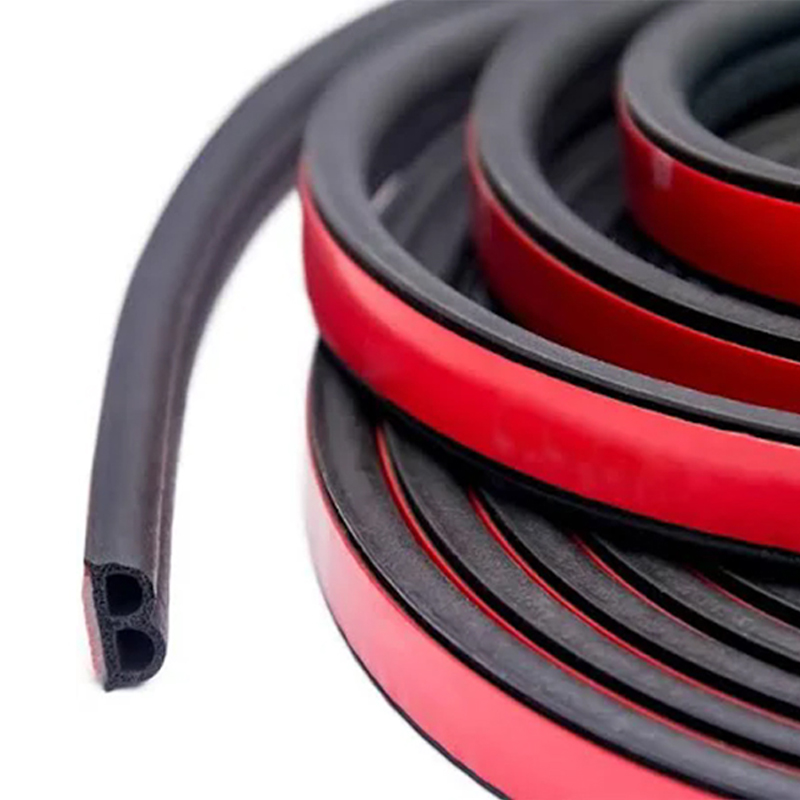
Durometer, measured on the Shore A scale for rubber, is a critical design factor for custom rubber extrusion profiles as it directly impacts both sealing effectiveness and mechanical support. A lower durometer (softer rubber, e.g., 40A) is highly flexible, conforms more easily to irregular surfaces, and requires less clamping force to seal effectively, which is ideal for low-pressure weather stripping. Conversely, a higher durometer (harder rubber, e.g., 80A) provides greater structural rigidity, higher abrasion resistance, and better resistance to compression set under high mechanical loads, making it suitable for mounting feet, bumpers, or components that need to maintain a fixed position. Selecting the correct durometer is a balance: too soft, and the profile may not withstand constant pressure; too hard, and it may not compress sufficiently to create a reliable seal, thus undermining the primary benefits of extruded rubber seals.
Yes, extruded rubber seals frequently need to be bonded or spliced to create continuous, closed-loop gaskets, a common requirement in manufacturing to ensure a full 360-degree seal. The two primary methods are cold bonding and hot splicing. Cold bonding uses a specialized adhesive, often a cyanoacrylate or solvent-based rubber cement, to chemically join the two ends of the profile. This method is fast but the resulting joint can be a point of weakness. Hot splicing, which is the preferred and more professional method, involves heating and fusing the cut ends using a specialized compound and mold. This process effectively vulcanizes the joint area, creating a seamless connection that restores the material's original mechanical properties, including elasticity and tensile strength. For high-performance EPDM rubber extrusion weather stripping or critical fluid seals, hot splicing is highly recommended for maximizing the long-term integrity of the seal.
Contact Us
Copyright ©
Jiaxing Tosun Rubber&Plastic Co., Ltd.
All Rights Reserved.
Custom Rubber And Plastics Products Factory